We Are Presented With the Notion Again That Humans Bring With Them Destruction and Pain and Cruelty

A human with a convict monkey seeking alms in Shanghai
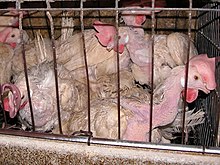
Egg laying hens in a factory farm battery cage

Parshwanatha, the 23rd Tirthankara, revived Jainism and ahimsa in the 9th century BCE, which led to a radical animal-rights movement in S Asia.[1]

Animate being rights is the philosophy according to which many or all sentient animals have moral worth that is independent of their utility for humans, and that their most basic interests—such as in avoiding suffering—should be afforded the same consideration as similar interests of human beings.[two] Broadly speaking, and particularly in popular discourse, the term "animal rights" is often used synonymously with "creature protection" or "animal liberation". More than narrowly, "animal rights" refers to the idea that many animals have cardinal rights to exist treated with respect equally individuals—rights to life, liberty, and freedom from torture that may non exist overridden by considerations of aggregate welfare.[iii]
Advocates for animal rights oppose the assignment of moral value and fundamental protections on the basis of species membership lone—an idea known as speciesism since 1970, when Richard D. Ryder adopted the term[4]—arguing that it is a prejudice every bit irrational as any other.[5] They maintain that animals should no longer be viewed as property or used every bit food, clothing, enquiry subjects, entertainment, or beasts of burden.[6] Multiple cultural traditions around the world such as Jainism, Taoism, Hinduism, Buddhism, Shintoism and Animism also espouse some forms of brute rights.
In parallel to the debate well-nigh moral rights, law schools in Due north America now often teach animate being police force,[seven] and several legal scholars, such as Steven M. Wise and Gary L. Francione, support the extension of basic legal rights and personhood to non-man animals. The animals nigh ofttimes considered in arguments for personhood are hominids. Some animal-rights academics support this considering it would interruption through the species bulwark, but others oppose it because information technology predicates moral value on mental complication, rather than on sentience alone.[eight] As of November 2019[update], 29 countries had enacted bans on hominoid experimentation; Argentina has granted a convict orangutan bones human rights since 2014.[9]
Outside the order of primates, animal-rights discussions nigh often accost the condition of mammals (compare charismatic megafauna). Other animals (considered less sentient) have gained less attention; insects relatively footling[10] (outside Jainism), and animal-like bacteria (despite their overwhelming numbers) inappreciably any.[11]
Critics of beast rights debate that nonhuman animals are unable to enter into a social contract, and thus cannot exist possessors of rights, a view summed up by the philosopher Roger Scruton (1944–2020), who writes that only humans have duties, and therefore only humans have rights.[12] Some other argument, associated with the utilitarian tradition, maintains that animals may exist used as resources so long as there is no unnecessary suffering;[thirteen] animals may have some moral continuing, but they are junior in status to human beings, and any interests they have may be overridden, though what counts as "necessary" suffering or a legitimate sacrifice of interests tin can vary considerably.[14] Certain forms of brute-rights activism, such equally the devastation of fur farms and of animal laboratories by the Animal Liberation Front, have attracted criticism, including from within the creature-rights movement itself,[fifteen] and have prompted reaction from the U.Southward. Congress with the enactment of laws, including the Animal Enterprise Terrorism Act, assuasive the prosecution of this sort of activity equally terrorism.[sixteen]
History [edit]
In religion [edit]
For some the basis of brute rights is in religion or animate being worship (or in general nature worship), with some religions banning killing of any animal, and in other religions animals can be considered unclean.
Hindu and Buddhist societies abased animal cede and embraced vegetarianism from the 3rd century BCE.[17] One of the most important sanctions of the Jain, Hindu and Buddhist faiths is the concept of ahimsa, or refraining from the destruction of life. According to Buddhist conventionalities, humans do not deserve preferential handling over other living beings.[eighteen] The Dharmic interpretation of this doctrine prohibits the killing of any living existence.[xviii] Ancient Tamil works such as the Tolkāppiyam and Tirukkural comprise passages that extend the thought of non-violence to all living beings.[nineteen]
In Islam, brute rights were recognized early by the Sharia. This recognition is based on both the Qur'an and the Hadith. In the Qur'an, there are many references to animals, detailing that they have souls, course communities, communicate with God and worship Him in their own style. Muhammad forbade his followers to harm whatever animal and asked them to respect the rights of animals.[xx]
Co-ordinate to Christianity, all animals, from the smallest to the largest, are cared for and loved. According to the Bible, "All these animals waited for the Lord, that the Lord might give them food at the hour. The Lord gives them, they receive; The Lord opens his hand, and they are filled with good things".[21] It farther says God "gave food to the animals, and made the crows cry."[22]
Philosophical and legal approaches [edit]
Overview [edit]

The ii chief philosophical approaches to animal ethics are utilitarian and rights-based. The one-time is exemplified by Peter Singer, and the latter by Tom Regan and Gary Francione. Their differences reflect a distinction philosophers depict between ethical theories that judge the rightness of an act by its consequences (consequentialism/teleological ethics, or utilitarianism), and those that focus on the principle backside the human action, near regardless of consequences (deontological ethics). Deontologists debate that in that location are acts we should never perform, even if declining to do so entails a worse consequence.[23]
There are a number of positions that tin exist dedicated from a consequentalist or deontologist perspective, including the capabilities approach, represented by Martha Nussbaum, and the egalitarian arroyo, which has been examined past Ingmar Persson and Peter Vallentyne. The capabilities arroyo focuses on what individuals crave to fulfill their capabilities: Nussbaum (2006) argues that animals demand a right to life, some control over their environment, company, play, and concrete health.[24]
Stephen R. Fifty. Clark, Mary Midgley, and Bernard Rollin besides talk over brute rights in terms of animals being permitted to lead a life appropriate for their kind.[25] Egalitarianism favors an equal distribution of happiness among all individuals, which makes the interests of the worse off more of import than those of the improve off.[26] Another approach, virtue ethics, holds that in considering how to human activity we should consider the grapheme of the thespian, and what kind of moral agents we should exist. Rosalind Hursthouse has suggested an arroyo to brute rights based on virtue ideals.[27] Mark Rowlands has proposed a contractarian arroyo.[28]
Utilitarianism [edit]
Nussbaum (2004) writes that utilitarianism, starting with Jeremy Bentham and John Stuart Mill, has contributed more to the recognition of the moral condition of animals than any other ethical theory.[29] The commonsensical philosopher most associated with brute rights is Peter Singer, professor of bioethics at Princeton University. Singer is not a rights theorist, but uses the language of rights to discuss how we ought to treat individuals. He is a preference utilitarian, meaning that he judges the rightness of an act by the extent to which information technology satisfies the preferences (interests) of those afflicted.[30]
His position is that there is no reason non to give equal consideration to the interests of human and nonhumans, though his principle of equality does not require identical handling. A mouse and a man both have an involvement in non being kicked, and there are no moral or logical grounds for failing to accordance those interests equal weight. Interests are predicated on the ability to suffer, cipher more than, and in one case it is established that a being has interests, those interests must be given equal consideration.[31] Singer quotes the English philosopher Henry Sidgwick (1838–1900): "The good of whatsoever one individual is of no more importance, from the point of view ... of the Universe, than the good of any other."[32]

Peter Singer: interests are predicated on the ability to suffer.
Singer argues that equality of consideration is a prescription, non an assertion of fact: if the equality of the sexes were based only on the idea that men and women were equally intelligent, we would have to abandon the practice of equal consideration if this were later found to be false. But the moral idea of equality does non depend on matters of fact such every bit intelligence, concrete strength, or moral chapters. Equality therefore cannot exist grounded on the outcome of scientific investigations into the intelligence of nonhumans. All that matters is whether they can endure.[33]
Commentators on all sides of the debate now accept that animals suffer and experience pain, although information technology was not always so. Bernard Rollin, professor of philosophy, animal sciences, and biomedical sciences at Colorado State Academy, writes that Descartes' influence continued to exist felt until the 1980s. Veterinarians trained in the The states earlier 1989 were taught to ignore pain, he writes, and at least 1 major veterinary hospital in the 1960s did not stock narcotic analgesics for animal pain control. In his interactions with scientists, he was oftentimes asked to "prove" that animals are conscious, and to provide "scientifically acceptable" show that they could feel hurting.[34]
Scientific publications take made it articulate since the 1980s that the majority of researchers do believe animals suffer and feel pain, though it continues to be argued that their suffering may be reduced past an disability to experience the same dread of anticipation every bit humans, or to remember the suffering every bit vividly.[35] The problem of animal suffering, and animal consciousness in general, arose primarily because it was argued that animals accept no language. Singer writes that, if language were needed to communicate pain, it would frequently be impossible to know when humans are in pain, though we can notice pain behavior and make a calculated guess based on it. He argues that in that location is no reason to suppose that the hurting beliefs of nonhumans would take a unlike meaning from the pain behavior of humans.[36]
Subjects-of-a-life [edit]

Tom Regan, professor emeritus of philosophy at North Carolina State Academy, argues in The Case for Animal Rights (1983) that nonhuman animals are what he calls "subjects-of-a-life", and as such are bearers of rights.[37] He writes that, because the moral rights of humans are based on their possession of sure cerebral abilities, and because these abilities are also possessed by at to the lowest degree some nonhuman animals, such animals must have the same moral rights equally humans. Although simply humans act equally moral agents, both marginal-case humans, such every bit infants, and at least some nonhumans must have the status of "moral patients".[37]
Moral patients are unable to formulate moral principles, and equally such are unable to do right or incorrect, even though what they exercise may exist beneficial or harmful. Just moral agents are able to engage in moral action. Animals for Regan have "intrinsic value" every bit subjects-of-a-life, and cannot exist regarded as a means to an terminate, a view that places him firmly in the abolitionist campsite. His theory does non extend to all animals, but only to those that can exist regarded equally subjects-of-a-life.[37] He argues that all normal mammals of at least one twelvemonth of age would authorize:
... individuals are subjects-of-a-life if they accept behavior and desires; perception, retentivity, and a sense of the future, including their ain hereafter; an emotional life together with feelings of pleasure and pain; preference- and welfare-interests; the ability to initiate action in pursuit of their desires and goals; a psychophysical identity over time; and an individual welfare in the sense that their experiential life fares well or sick for them, logically independently of their utility for others and logically independently of their being the object of anyone else'due south interests.[37]
Whereas Singer is primarily concerned with improving the treatment of animals and accepts that, in some hypothetical scenarios, individual animals might be used legitimately to further man or nonhuman ends, Regan believes we ought to care for nonhuman animals as we would humans. He applies the strict Kantian ideal (which Kant himself applied but to humans) that they ought never to exist sacrificed as a ways to an end, and must exist treated as ends in themselves.[38]
Abolition [edit]

Gary Francione: animals need but the right not to exist regarded as holding.
Gary Francione, professor of law and philosophy at Rutgers Constabulary Schoolhouse in Newark, is a leading abolitionist writer, arguing that animals need only one right, the correct not to be endemic. Everything else would follow from that prototype shift. He writes that, although nigh people would condemn the mistreatment of animals, and in many countries at that place are laws that seem to reverberate those concerns, "in practice the legal system allows any use of animals, withal abhorrent." The law only requires that any suffering not be "unnecessary". In deciding what counts as "unnecessary", an brute's interests are weighed against the interests of human beings, and the latter almost always prevail.[39]
Francione's Animals, Holding, and the Law (1995) was the first extensive jurisprudential handling of animal rights. In it, Francione compares the situation of animals to the treatment of slaves in the United States, where legislation existed that appeared to protect them while the courts ignored that the institution of slavery itself rendered the protection unenforceable.[twoscore] He offers as an instance the U.s. Creature Welfare Act, which he describes every bit an case of symbolic legislation, intended to assuage public concern about the treatment of animals, but hard to implement.[41]
He argues that a focus on fauna welfare, rather than creature rights, may worsen the position of animals by making the public feel comfy about using them and entrenching the view of them equally belongings. He calls animal rights groups who pursue creature welfare bug, such equally People for the Ethical Treatment of Animals, the "new welfarists", arguing that they take more in common with 19th-century animate being protectionists than with the creature rights movement; indeed, the terms "fauna protection" and "protectionism" are increasingly favored. His position in 1996 was that there is no fauna rights motility in the U.s.a..[42]
Contractarianism [edit]
Mark Rowlands, professor of philosophy at the University of Florida, has proposed a contractarian arroyo, based on the original position and the veil of ignorance—a "state of nature" thought experiment that tests intuitions about justice and fairness—in John Rawls's A Theory of Justice (1971). In the original position, individuals choose principles of justice (what kind of society to grade, and how main social goods volition be distributed), unaware of their individual characteristics—their race, sex, class, or intelligence, whether they are able-bodied or disabled, rich or poor—and therefore unaware of which office they will assume in the order they are nigh to grade.[28]
The idea is that, operating backside the veil of ignorance, they will cull a social contract in which in that location is basic fairness and justice for them no matter the position they occupy. Rawls did not include species membership equally i of the attributes hidden from the conclusion-makers in the original position. Rowlands proposes extending the veil of ignorance to include rationality, which he argues is an undeserved property similar to characteristics including race, sex and intelligence.[28]
Prima facie rights theory [edit]
American philosopher Timothy Garry has proposed an approach that deems nonhuman animals worthy of prima facie rights. In a philosophical context, a prima facie (Latin for "on the confront of it" or "at kickoff glance") right is one that appears to be applicable at first glance, merely upon closer examination may be outweighed by other considerations. In his book Ethics: A Pluralistic Approach to Moral Theory, Lawrence Hinman characterizes such rights every bit "the right is real simply leaves open the question of whether it is applicative and overriding in a particular situation".[43] The idea that nonhuman animals are worthy of prima facie rights is to say that, in a sense, animals have rights that can be overridden by many other considerations, especially those alien a homo'due south right to life, liberty, property, and the pursuit of happiness. Garry supports his view arguing:
... if a nonhuman animal were to impale a human existence in the U.S., information technology would accept broken the laws of the land and would probably get rougher sanctions than if it were a human. My betoken is that like laws govern all who interact within a society, rights are to be practical to all beings who interact within that society. This is non to say these rights endowed by humans are equivalent to those held by nonhuman animals, but rather that if humans possess rights and so and so must all those who interact with humans.[44]
In sum, Garry suggests that humans accept obligations to nonhuman animals; animals do not, and ought not to, take uninfringible rights against humans.
Feminism and animal rights [edit]

The American ecofeminist Carol Adams has written extensively nigh the link betwixt feminism and creature rights, starting with The Sexual Politics of Meat (1990).
Women have played a cardinal role in animal advocacy since the 19th century.[45] The anti-vivisection movement in the 19th and early on 20th century in England and the United States was largely run by women, including Frances Power Cobbe, Anna Kingsford, Lizzy Lind af Hageby and Caroline Earle White (1833–1916).[46] Garner writes that 70 per cent of the membership of the Victoria Street Society (i of the anti-vivisection groups founded past Cobbe) were women, as were 70 per cent of the membership of the British RSPCA in 1900.[47]
The modernistic animal advocacy movement has a like representation of women. They are not invariably in leadership positions: during the March for Animals in Washington, D.C., in 1990—the largest brute rights demonstration held until then in the United States—about of the participants were women, only near of the platform speakers were men.[48] Nevertheless, several influential animal advocacy groups have been founded by women, including the British Spousal relationship for the Abolition of Vivisection past Cobbe in London in 1898; the Creature Welfare Board of India by Rukmini Devi Arundale in 1962; and People for the Ethical Treatment of Animals, co-founded by Ingrid Newkirk in 1980. In the netherlands, Marianne Thieme and Esther Ouwehand were elected to parliament in 2006 representing the Parliamentary group for Animals.
The preponderance of women in the movement has led to a body of academic literature exploring feminism and animate being rights; feminism and vegetarianism or veganism, the oppression of women and animals, and the male association of women and animals with nature and emotion, rather than reason—an association that several feminist writers take embraced.[45] Lori Gruen writes that women and animals serve the same symbolic function in a patriarchal guild: both are "the used"; the dominated, submissive "Other".[49] When the British feminist Mary Wollstonecraft (1759–1797) published A Vindication of the Rights of Woman (1792), Thomas Taylor (1758–1835), a Cambridge philosopher, responded with an anonymous parody, A Vindication of the Rights of Brutes (1792), saying that Wollstonecraft'due south arguments for women's rights could be practical equally to animals, a position he intended as reductio ad absurdum.[50]
Transhumanism [edit]
Some transhumanists argue for animal rights, liberation, and "uplift" of animal consciousness into machines.[51] Transhumanism also understands creature rights on a gradation or spectrum with other types of sentient rights, including human rights and the rights of conscious bogus intelligences (posthuman rights).[52]
Critics [edit]
R. Grand. Frey [edit]
R. G. Frey, professor of philosophy at Bowling Green State University, is a preference commonsensical, as is Vocaliser. Merely, in his early work, Interests and Rights (1980), Frey disagreed with Singer – who in his Animal Liberation (1975) wrote that the interests of nonhuman animals must be included when judging the consequences of an act – on the grounds that animals take no interests. Frey argues that interests are dependent on desire, and that no want can exist without a respective conventionalities. Animals have no beliefs, because a belief country requires the ability to concur a second-society belief—a belief most the belief—which he argues requires language: "If someone were to say, due east.g. 'The cat believes that the door is locked,' then that person is holding, as I see it, that the true cat holds the declarative sentence 'The door is locked' to be true; and I can see no reason whatever for crediting the cat or any other creature which lacks language, including homo infants, with entertaining declarative sentences."[53]
Carl Cohen [edit]
Carl Cohen, professor of philosophy at the University of Michigan, argues that rights holders must be able to distinguish between their own interests and what is right. "The holders of rights must accept the chapters to comprehend rules of duty governing all, including themselves. In applying such rules, [they] ... must recognize possible conflicts between what is in their own interest and what is but. Only in a customs of beings capable of self-restricting moral judgments tin the concept of a right exist correctly invoked." Cohen rejects Vocaliser'due south argument that, since a brain-damaged human could non make moral judgments, moral judgments cannot be used as the distinguishing characteristic for determining who is awarded rights. Cohen writes that the test for moral judgment "is not a test to exist administered to humans one past 1", simply should exist practical to the capacity of members of the species in general.[54]
Richard Posner [edit]

Judge Richard Posner of the United States Courtroom of Appeals for the Seventh Excursion debated the issue of animal rights in 2001 with Peter Vocalist.[56] Posner posits that his moral intuition tells him "that human beings adopt their ain. If a dog threatens a human being infant, even if it requires causing more than pain to the canis familiaris to stop it, than the dog would take caused to the baby, then we favour the child. It would exist monstrous to spare the dog."[55]
Singer challenges this by arguing that formerly diff rights for gays, women, and sure races were justified using the same set of intuitions. Posner replies that equality in civil rights did not occur because of ethical arguments, simply because facts mounted that there were no morally significant differences between humans based on race, sex, or sexual orientation that would support inequality. If and when similar facts emerge about humans and animals, the differences in rights volition erode too. But facts will drive equality, not ethical arguments that run contrary to instinct, he argues. Posner calls his approach "soft utilitarianism", in contrast to Vocalizer'south "hard utilitarianism". He argues:
The "soft" utilitarian position on brute rights is a moral intuition of many, probably most, Americans. Nosotros realize that animals feel pain, and we think that to inflict pain without a reason is bad. Nada of practical value is added by dressing up this intuition in the language of philosophy; much is lost when the intuition is fabricated a stage in a logical argument. When kindness toward animals is levered into a duty of weighting the pains of animals and of people equally, bizarre vistas of social engineering are opened upwardly.[55]

Roger Scruton [edit]
Roger Scruton, the British philosopher, argued that rights imply obligations. Every legal privilege, he wrote, imposes a burden on the i who does not possess that privilege: that is, "your correct may be my duty." Scruton therefore regarded the emergence of the animate being rights move as "the strangest cultural shift within the liberal worldview", because the idea of rights and responsibilities is, he argued, distinctive to the homo condition, and it makes no sense to spread them beyond our ain species.[12]
He accused creature rights advocates of "pre-scientific" anthropomorphism, attributing traits to animals that are, he says, Beatrix Potter-similar, where "only homo is vile." It is within this fiction that the appeal of animal rights lies, he argued. The world of animals is non-judgmental, filled with dogs who return our amore almost no matter what we do to them, and cats who pretend to be affectionate when, in fact, they intendance simply most themselves. It is, he argued, a fantasy, a world of escape.[12]
Scruton singled out Peter Vocaliser, a prominent Australian philosopher and animal-rights activist, for criticism. He wrote that Vocalizer'due south works, including Animal Liberation, "comprise little or no philosophical argument. They derive their radical moral conclusions from a vacuous utilitarianism that counts the hurting and pleasure of all living things equally as meaning and that ignores just almost everything that has been said in our philosophical tradition most the real distinction between persons and animals."[12]
Tom Regan countered this view of rights by distinguishing moral agents and moral patients.[57] [ unreliable source? ]
Public attitudes [edit]
According to a paper published in 2000 by Harold Herzog and Lorna Dorr, previous bookish surveys of attitudes towards beast rights accept tended to suffer from small sample sizes and not-representative groups.[58] However, a number of factors appear to correlate with the attitude of individuals regarding the treatment of animals and animal rights. These include gender, age, occupation, faith, and level of education. At that place has also been show to suggest that prior experience with pets may be a cistron in people's attitudes.[59]
Women are more probable to empathize with the crusade of fauna rights than men.[59] [60] A 1996 study suggested that factors that may partially explain this discrepancy include attitudes towards feminism and science, scientific literacy, and the presence of a greater emphasis on "nurturance or pity" among women.[61]
A common misconception on the concept of animal rights is that its proponents want to grant non-human being animals the verbal same legal rights as humans, such every bit the correct to vote. This is non the example, as the concept is that animals should have rights with equal consideration to their interests (for instance, cats do non have any interest in voting, so they should non take the right to vote).[62] A 2016 study establish that support for brute testing may not be based on cogent philosophical rationales, and more than open up debate is warranted.[63]
A 2007 survey to examine whether or not people who believed in development were more likely to support animal rights than creationists and believers in intelligent design found that this was largely the case – according to the researchers, the respondents who were potent Christian fundamentalists and believers in creationism were less likely to advocate for beast rights than those who were less fundamentalist in their beliefs. The findings extended previous enquiry, such as a 1992 study which found that 48% of animate being rights activists were atheists or agnostic.[64] [65] A 2019 study in The Washington Post constitute that those who accept positive attitudes toward fauna rights as well tend to accept a positive view of universal healthcare, favor reducing bigotry confronting African Americans, the LGBT community and undocumented immigrants, and expanding welfare to aid the poor.[66]
Two surveys institute that attitudes towards animal rights tactics, such every bit direct activeness, are very various within the brute rights communities. About half (50% and 39% in two surveys) of activists exercise not support direct activity. One survey ended "information technology would exist a mistake to portray animal rights activists as homogeneous."[59] [67]
Run into also [edit]
-
 Animals portal
 - Animal cognition
- Animate being consciousness
- Fauna–industrial complex
- Animal liberation
- Animal liberation move
- Animal liberationist
- Creature rights by country or territory
- Beast studies
- Brute trial
- Brute Welfare Establish
- Antinaturalism (politics)
- Cambridge Proclamation on Consciousness
- Chick culling
- Disquisitional animal studies
- Deep ecology
- Do Animals Take Rights? (book)
- List of beast rights advocates
- List of songs about animal rights
- Open up rescue
- Constitute rights
- Sentientism
- Timeline of beast welfare and rights
- Wild creature suffering
- Globe Animal Day
References [edit]
- ^ Kumar, Satish (September 2002). You are, therefore I am: A declaration of dependence. ISBN9781903998182.
- ^ DeGrazia (2002), ch. two; Taylor (2009), ch. 1.
- ^ Taylor (2009), ch. 3.
- ^ Compare for example similar usage of the term in 1938: The American Biology Teacher. Vol. 53. National Association of Biology Teachers. 1938. p. 211. Retrieved 16 April 2021.
The foundation from which these behaviors bound is the ideology known as speciesism. Speciesism is deeply rooted in the widely-held belief that the human species is entitled to certain rights and privileges.
- ^ Horta (2010).
- ^ That a central goal of fauna rights is to eliminate the property condition of animals, see Sunstein (2004), p. 11ff.
- For speciesism and fundamental protections, come across Waldau (2011).
- For nutrient, clothing, research subjects or entertainment, see Francione (1995), p. 17.
- ^ "Animal Law Courses". Animal Legal Defense Fund.
- ^ For brute-law courses in North America, run across "Animal law courses" Archived 2010-06-13 at the Wayback Car, Fauna Legal Defense Fund. Retrieved July 12, 2012.
- For a discussion of animals and personhood, see Wise (2000), pp. 4, 59, 248ff; Wise (2004); Posner (2004); Wise (2007).
- For the arguments and counter-arguments about application personhood just to great apes, see Garner (2005), p. 22.
- As well see Sunstein, Cass R. (Feb twenty, 2000). "The Chimps' Mean solar day in Court", The New York Times.
- ^ Giménez, Emiliano (Jan 4, 2015). "Argentine orangutan granted unprecedented legal rights". edition.cnn.com. CNN Espanol. Retrieved April 21, 2015.
- ^ Cohen, Carl; Regan, Tom (2001). The Beast Rights Debate. Point/Counterpoint: Philosophers Debate Contemporary Bug Series. Lanham, Maryland: Rowman & Littlefield Publishers. p. 47. ISBN9780847696628 . Retrieved 16 April 2021.
Too often overlooked in the brute world, according to Sapontzis, are insects that have interests, and therefore rights.
- ^ The concept of "bacteria rights" can appear coupled with disdain or irony: Pluhar, Evelyn B. (1995). "Human being "superiority" and the argument from marginal cases". Beyond Prejudice: The Moral Significance of Human and Nonhuman Animals. Book collections on Project MUSE. Durham, North Carolina: Knuckles University Press. p. 9. ISBN9780822316480 . Retrieved 16 Apr 2021.
For case, in an editorial entitled 'Animal Rights Nonsense,' ... in the prestigious science periodical Nature, defenders of brute rights are accused of existence committed to the absurdity of 'bacteria rights.'
- ^ a b c d Scruton, Roger (Summertime 2000). "Animal Rights". Urban center Journal. New York: Manhattan Plant for Policy Inquiry.
- ^ Liguori, G.; et al. (2017). "Ethical Issues in the Use of Animal Models for Tissue Engineering science: Reflections on Legal Aspects, Moral Theory, 3Rs Strategies, and Harm-Benefit Analysis" (PDF). Tissue Technology Part C: Methods. 23 (12): 850–862. doi:10.1089/ten.TEC.2017.0189. PMID 28756735.
- ^ Garner (2005), pp. 11, 16.
- Also see Frey (1980); and for a review of Frey, see Sprigge (1981).
- ^ Vocalist (2000), pp. 151–156.
- ^ Martin, Gus (15 June 2011). The SAGE Encyclopedia of Terrorism, Second Edition. SAGE. ISBN9781412980166 – via Google Books.
- ^ Garner (2005), pp. 21–22.
- ^ a b Grant, Catharine (2006). The No-nonsense Guide to Beast Rights . New Internationalist. p. 24. ISBN9781904456407.
These religions emphasize ahimsa, which is the principle of not-violence towards all living things. The showtime precept is a prohibition against the killing of any creature. The Jain, Hindu and Buddhist injunctions against killing serve to teach that all creatures are spiritually equal.
- ^ Meenakshi Sundaram, T. P. (1957). "Vegetarianism in Tamil Literature". 15th World Vegetarian Congress 1957. International Vegetarian Union (IVU). Retrieved 17 April 2022.
Ahimsa is the ruling principle of Indian life from the very earliest times. ... This positive spiritual attitude is hands explained to the common human in a negative way as "ahimsa" and hence this fashion of denoting it. Tiruvalluvar speaks of this as "kollaamai" or "not-killing."
- ^ "BBC - Religions - Islam: Animals". bbc.co.u.k..
- ^ Proverbs 30:24 and NW; Psalm 104:24, 25, 27, 28
- ^ Ps 147:9
- ^ Craig (1988).
- ^ Nussbaum (2006), pp. 388ff, 393ff; also see Nussbaum (2004), p. 299ff.
- ^ Weir (2009): see Clark (1977); Rollin (1981); Midgley (1984).
- ^ Vallentyne (2005); Vallentyne (2007).
- ^ Rowlands (2009), p. 98ff; Hursthouse (2000a); Hursthouse (2000b), p. 146ff.
- ^ a b c Rowlands (1998), p. 118ff, particularly pp. 147–152.
- ^ Nussbaum (2004), p. 302.
- ^ For a word of preference utilitarianism, see Singer (2011), pp. 14ff, 94ff.
- ^ Singer (1990), pp. 7–8.
- ^ Singer 1990, p. 5.
- ^ Vocaliser (1990), p. 4.
- ^ Rollin (1989), pp. xii, pp. 117–118; Rollin (2007).
- ^ Singer (1990), pp. x–17, citing Stamp Dawkins (1980), Walker (1983), and Griffin (1984); Garner (2005), pp. 13–xiv.
- ^ Vocalist (1990) p. 12ff.
- ^ a b c d Regan (1983), p. 243.
- ^ Regan (1983).
- ^ Francione (1990), pp. 4, 17ff.
- ^ Francione (1995), pp. 4–five.
- ^ Francione (1995), p. 208ff.
- ^ Francione (1996), p. 32ff
- Francione and Garner (2010), pp. 1ff, 175ff.
- Hall, Lee. "An Interview with Professor Gary Fifty. Francione" Archived May 8, 2009, at the Wayback Machine, Friends of Animals. Retrieved February 3, 2011.
- ^ Hinman, Lawrence M. Ethics: A Pluralistic Approach to Moral Theory. Fort Worth, TX: Harcourt Brace College, 1998. Print.
- ^ Garry, Timothy J. Nonhuman Animals: Possessors of Prima Facie Rights (2012), p.6
- ^ a b Lansbury (1985); Adams (1990); Donovan (1993); Gruen (1993); Adams (1994); Adams and Donovan (1995); Adams (2004); MacKinnon (2004).
- ^ Kean (1995).
- ^ Garner (2005), p. 141, citing Elston (1990), p. 276.
- ^ Garner (2005), pp. 142–143.
- ^ Gruen (1993), p. 60ff.
- ^ Singer (1990), p. 1.
- ^ George Dvorsky. "The Ethics of Animal Enhancement".
- ^ Evans, Woody (2015). "Posthuman Rights: Dimensions of Transhuman Worlds". Teknokultura. 12 (2). doi:10.5209/rev_TK.2015.v12.n2.49072.
- ^ Frey (1989), p. xl.
- ^ pg. 94-100. Cohen and Regan (2001).
- ^ a b c Posner (June 15, 2001); Posner-Vocalizer debate in full, courtesy link on utilitarian.internet.
- Also meet Posner (2004).
- ^ Singer (June 15, 2001).
- ^ "Tom Regan: The Case For Brute Rights". The Vegetarian Site . Retrieved November 2, 2019.
- ^ Herzog, Harold; Dorr, Lorna (2000). "Electronically Available Surveys of Attitudes Toward Animals". Society & Animals. 10 (ii).
- ^ a b c Apostol, Fifty.; Rebega, O.L.; Miclea, Chiliad. (2013). "Psychological and Socio-Demographic Predictors of Attitudes towards Animals". Social and Behavioural Sciences (78): 521–525.
- ^ Herzog, Harold (2007). "Gender Differences in Man-Animal Interactions: A Review". Anthrozoös. 20 (ane): 7–21.
- ^ Pifer, Linda (1996). "Exploring the Gender Gap in Young Adults' Attitudes almost Beast Research" (PDF). Social club and Animals. iv (1): 37–52. doi:ten.1163/156853096X00034. PMID 11654528.
- ^ "Ethics - Animal ethics: Animal rights". BBC Online . Retrieved Feb 10, 2022.
- ^ Joffe, Ari R.; Bara, Meredith; Anton, Natalie; Nobis, Nathan (March 29, 2016). "The ethics of animal enquiry: a survey of the public and scientists in Due north America". BMC Medical Ethics. 17: 17. doi:ten.1186/s12910-016-0100-ten. ISSN 1472-6939. PMC4812627. PMID 27025215.
- ^ DeLeeuwa, Jamie; Galen, Luke; Aebersold, Cassandra; Stanton, Victoria (2007). "Support for Animal Rights every bit a Role of Belief in Development, Religious Fundamentalism, and Religious Denomination" (PDF). Society and Animals (15): 353–363. Archived from the original (PDF) on June 20, 2013.
- ^ Galvin, Shelley L.; Herzog Jr., Harold A. (1992). "Upstanding Ideology, Animal Rights Activism, And Attitudes Toward The Treatment Of Animals". Ethics & Beliefs. 2 (iii): 141–149. doi:10.1207/s15327019eb0203_1. PMID 11651362.
- ^ Park, Yon Soo; Valentino, Benjamin (July 26, 2019). "Who supports animal rights? Here's what we found". The Washington Post . Retrieved July 26, 2019.
- ^ Plous, South. (1991). "An attitude survey of beast rights activists". Psychological Science. 2 (3): 194–196. doi:x.1111/j.1467-9280.1991.tb00131.x. S2CID 145549994.
Bibliography [edit]
Books and papers are cited in short form in the footnotes, with full citations here. News and other sources are cited in total in the footnotes.
- Adams, Carol J. (1996). The Sexual Politics of Meat: A Feminist-Vegetarian Critical Theory. Continuum. ISBN 1501312839
- Adams, Carol J.; Donovan, Josephine, eds. (1995). Animals and Women: Feminist Theoretical Explorations. Duke University Press. ISBN 0822316552
- Adams, Carol J. (2004). The Pornography of Meat. Continuum. ISBN 9781590565100
- Benthall, Jonathan (2007). "Beast liberation and rights", Anthropology Today, volume 23, upshot 2, April.
- Bentham, Jeremy (1781). Principles of Penal Law. ISBN 1379912326
- Beauchamp, Tom (2009). "The Moral Standing of Animals", in Marc Bekoff. Encyclopedia of Animal Rights and Fauna Welfare. Greenwood. ISBN 0313352593
- Beauchamp, Tom (2011a). "Introduction," in Tom Beauchamp and R.G. Frey (eds.). The Oxford Handbook of Creature Ethics. Oxford Academy Printing. ISBN 019935197X
- Beauchamp, Tom (2011b). "Rights Theory and Animal Rights," in Beauchamp and Frey, op cit. ISBN 019935197X
- Clark, Stephen R. L. (1977). The Moral Status of Animals. Oxford University Press. ISBN 0192830406
- Cohen, Carl (1986). "The Instance for the Apply of Animals in Biomedical Enquiry", New England Journal of Medicine, vol. 315, issue 14, Oct, pp. 865–870.
- Cohen, Carl and Regan, Tom (2001). The Animal Rights Debate. Rowman & Littlefield. ISBN 0847696626
- Craig, Edward (ed.) (1988). "Deontological Ethics" and "Consequentalism," Routledge Encyclopedia of Philosophy.
- DeGrazia, David (2002). Animal Rights: A Very Short Introduction. Oxford University Printing.
- Donovan, Josephine (1993). "Creature Rights and Feminist Theory," in Greta Gaard. Ecofeminism: Women, Animals, Nature. Temple University Press.
- Francione, Gary (1996). Rain Without Thunder: The Ideology of the Animal Rights Movement. Temple University Press.
- Francione, Gary (1995). Animals, Belongings, and the Constabulary. Temple University Press.
- Francione, Gary (2008). Animals as Persons. Columbia University Press.
- Francione, Gary and Garner, Robert (2010). The Beast Rights Contend: Abolition Or Regulation?. Columbia University Press.
- Fellenz, Mark R. (2007). The Moral Menagerie: Philosophy and Fauna Rights. University of Illinois Press.
- Frey, R.Chiliad. (1980). Interests and Rights: The Case confronting Animals. Clarendon Press.
- Frey, R.Thousand. (1989). "Why Animals Lack Behavior and Desires," in Peter Vocaliser and Tom Regan (eds.). Animal Rights and Human being Obligations. Prentice Hall.
- Garner, Robert (2004). Animals, Politics and Morality. Manchester University Press.
- Garner, Robert (2005). The Political Theory of Animals Rights. Manchester University Press.
- Giannelli, Michael A. (1985). "Three Blind Mice, See How They Run: A Critique of Behavioral Enquiry With Animals". In G.Due west. Fox & L.D. Mickley (Eds.), Advances in Animal Welfare Scientific discipline 1985/1986 (pp. 109–164). Washington, DC: The Humane Guild of the The states
- Gruen, Lori (1993). "Dismantling Oppression: An Analysis of the Connection Between Women and Animals", in Greta Gaard. Ecofeminism: Women, Animals, Nature. Temple University Press.
- Griffin, Donald (1984). Brute Thinking. Harvard Academy Press.
- Horta, Oscar (2010). "What Is Speciesism?", The Journal of Environmental and Agronomical Ethics, Vol. 23, No. three, June, pp. 243–266.
- Hursthouse, Rosalind (2000a). On Virtue Ideals. Oxford University Press.
- Hursthouse, Rosalind (2000b). Ethics, Humans and Other Animals. Routledge.
- Kant, Immanuel (1785). Groundwork of the Metaphysic of Morals.
- Kean, Hilda (1995). "The 'Smooth Cool Men of Science': The Feminist and Socialist Response to Vivisection", History Workshop Periodical, No. xl (Autumn), pp. 16–38.
- Kelch, Thomas M. (2011). Globalization and Beast Constabulary. Kluwer Law International.
- Lansbury, Coral (1985). The Former Brown Dog: Women, Workers, and Vivisection in Edwardian England. University of Wisconsin Press.
- Legge, Debbi and Brooman, Simon (1997). Law Relating to Animals. Cavendish Publishing. ISBN 1859412386
- Leneman, Leah (1999). "No Animal Nutrient: The Road to Veganism in Britain, 1909–1944," Social club and Animals, 7, 1–v.
- Locke, John (1693). Some Thoughts Concerning Education.
- MacKinnon, Catharine A. (2004). "Of Mice and Men," in Nussbaum and Sunstein, op cit.
- Stonemason, Peter (1997). The Brown Dog Affair. Two Sevens Publishing.
- Midgley, Mary (1984). Animals and Why They Matter. University of Georgia Printing. ISBN 0820320412
- Molland, Neil (2004). "Thirty Years of Direct Activeness" in Best and Nocella, op cit.
- Monaghan, Rachael (2000). "Terrorism in the Proper name of Animal Rights," in Taylor, Maxwell and Horgan, John. The Future of Terrorism. Routledge.
- Murray, L. (2006). "The ASPCA–Pioneers in Brute Welfare", Encyclopædia Britannica'southward Advocacy for Animals.
- Nash, Roderick (1989). The Rights of Nature: A History of Ecology Ethics. Academy of Wisconsin Press.
- Newkirk, Ingrid (2004). "The ALF: Who, Why, and What?", in Steven All-time and Anthony Nocella. (eds).Terrorists or Freedom Fighters? Reflections on the Liberation of Animals. Lantern 2004.
- Nussbaum, Martha (2004). "Across Compassion and Humanity: Justice for Nonhuman Animals", in Cass Sunstein and Martha Nussbaum (eds.). Brute Rights: Current Debates and New Directions. Oxford University Press.
- Nussbaum, Martha (2006). Frontiers of Justice: Disability, Nationality, Species Membership. Belknap Press.
- Posner, Richard and Singer, Peter (June fifteen, 2001). Posner-Singer debate, Slate.
- Posner, Richard and Singer, Peter (2004). "Animal rights" in Sunstein and Nussbaum, op cit.
- Rachels, James (2009). "Darwin, Charles," in Bekoff, op cit.
- Redclift, Michael R. (2010). The International Handbook of Environmental Sociology. Edward Elgar Publishing.
- Regan, Tom (1983). The Case for Animal Rights. Academy of California Press.
- Regan, Tom (2001). Defending Animal Rights. University of Illinois Printing.
- Rollin, Bernard (1981). Beast Rights and Homo Morality. Prometheus Books.
- Rollin, Bernard (1989). The Unheeded Weep: Animate being Consciousness, Creature Hurting, and Scientific discipline. New York: Oxford University Printing.
- Rollin, Bernard (2007). "Animal inquiry: a moral science", Nature, EMBO Reports 8, half-dozen, pp. 521–525.
- Rowlands, Marker (2009) [1998]. Animal Rights. A Defense. Palgrave Macmillan.
- Ryder, Richard (2000) [1989]. Animal Revolution: Irresolute Attitudes Towards Speciesism. Berg.
- Sapontzis, Steve (1985). "Moral Community and Beast Rights", American Philosophical Quarterly, Vol. 22, No. iii (July), pp. 251–257.
- Scruton, Roger (1998). Animal Rights and Wrongs. Claridge Press.
- Scruton, Roger (2000). "Animal Rights", City Periodical, summertime.
- Singer, Peter (April 5, 1973). "Animal liberation", The New York Review of Books, Volume twenty, Number v.
- Vocalizer, Peter (1990) [1975]. Animal Liberation. New York Review Books.
- Singer, Peter (2000) [1998]. Ethics into Action: Henry Spira and the Animal Rights Movement. Rowman and Littlefield Publishers, Inc.
- Singer, Peter (2003). "Animal liberation at 30", The New York Review of Books, vol l, no. 8, May 15.
- Singer, Peter (2004). "Ethics Beyond Species and Beyond Instincts," in Sunstein and Nussbaum, op cit.
- Singer, Peter (2011) [1979]. Practical Ideals. Cambridge University Press.
- Sprigge, T.L.Due south. (1981) "Interests and Rights: The Instance against Animals", Journal of Medical Ethics. June, vii(2): 95–102.
- Stamp Dawkins, Marian (1980). Animal Suffering: The Science of Creature Welfare. Chapman and Hall.
- Stucki, Saskia (2020) "Towards a Theory of Legal Animal Rights: Simple and Key Rights", Oxford Journal of Legal Studies 40:533-560.
- Sunstein, Cass R. (2004). "Introduction: What are Animal Rights?" in Sunstein and Nussbaum, op cit.
- Sunstein, Cass R. and Nussbaum, Martha (2005). Animal Rights: Current Debates and New Directions. Oxford University Press. ISBN 0195305108
- Taylor, Angus (2009). Animals and Ethics: An Overview of the Philosophical Debate. Broadview Press.
- Taylor, Thomas (1792). "A Vindication of the Rights of Brutes," in Craciun, Adriana (2002). A Routledge Literary Sourcebook on Mary Wollstonecraft'southward A Vindication of the Rights of Woman. Routledge.
- Vallentyne, Peter (2005). "Of Mice and Men: Equality and Animals", The Periodical of Ethics, Vol. nine, No. 3/iv, pp. 403–433.
- Vallentyne, Peter (2007). "Of Mice and Men: Equality and Animals" in Nils Holtug, and Kasper Lippert-Rasmussen (eds.) (2007). Egalitarianism: New Essays on the Nature and Value of Equality. Oxford University Printing.
- Waldau, Paul (2011). Animal Rights: What Everyone Needs to Know. Oxford University Press.
- Walker, Stephen (1983). Animal Thoughts. Routledge.
- Weir, Jack (2009). "Virtue Ethics," in Marc Bekoff. Encyclopedia of Animal Rights and Animal Welfare. Greenwood. ISBN 0313352593
- Williams, Erin E. and DeMello, Margo (2007). Why Animals Matter. Prometheus Books.
- Wise, Steven M. (2000). Rattling the Cage: Toward Legal Rights for Animals. Da Capo Press.
- Wise, Steven M. (2002). Cartoon the Line: Scientific discipline and the Instance for Animal Rights. Perseus.
- Wise, Steven 1000. (2004). "Animal Rights, One Pace at a Time," in Sunstein and Nussbaum, op cit.
- Wise, Steven M. (2007). "Animal Rights", Encyclopædia Britannica.
Further reading [edit]
- Lubinski, Joseph (2002). "Overview Summary of Creature Rights", The Animal Legal and Historical Center at Michigan State Academy Higher of Law.
- "Groovy Apes and the Law", The Brute Legal and Historical Center at Michigan State University Higher of Law.
- Bekoff, Marc (ed.) (2009). The Encyclopedia of Animal Rights and Fauna Welfare. Greenwood.
- Best, Steven and Nocella 2, Anthony J. (eds). (2004). Terrorists or Freedom Fighters? Reflections on the Liberation of Animals. Lantern Books
- Chapouthier, Georges and Nouët, Jean-Claude (eds.) (1998). The Universal Declaration of Creature Rights. Ligue Française des Droits de fifty'Animal.
- Dawkins, Richard (1993). Gaps in the mind, in Cavalieri, Paola and Singer, Peter (eds.). The Great Ape Project. St. Martin'southward Griffin.
- Dombrowski, Daniel (1997). Babies and Beasts: The Argument from Marginal Cases. University of Illinois Press.
- Foltz, Richard (2006). Animals in Islamic Tradition and Muslim Cultures. Oneworld Publications.
- Franklin, Julian H. (2005). Fauna Rights and Moral Philosophy. University of Columbia Printing.
- Gruen, Lori (2003). "The Moral Status of Animals", Stanford Encyclopedia of Philosophy, July 1, 2003.
- _________ (2011). Ideals and Animals. Cambridge University Press.
- Hall, Lee (2006). Capers in the Churchyard: Creature Rights Advancement in the Historic period of Terror. Nectar Bat Press.
- Linzey, Andrew and Clarke, Paul A. B.(eds.) (1990). Animal Rights: A Historic Anthology. Columbia University Press.
- Mann, Keith (2007). From Dusk 'til Dawn: An Insider'south View of the Growth of the Animate being Liberation Movement. Puppy Pincher Printing.
- McArthur, Jo-Anne and Wilson, Keith (eds). (2020). Hidden: Animals in the Anthropocene. Lantern Publishing & Media.
- Neumann, Jean-Marc (2012). "The Universal Proclamation of Animal Rights or the Creation of a New Equilibrium between Species". Creature Police force Review volume 19-ane.
- Nibert, David (2002). Animal Rights, Homo Rights: Entanglements of Oppression and Liberation. Rowman and Litterfield.
- Patterson, Charles (2002). Eternal Treblinka: Our Treatment of Animals and the Holocaust. Lantern.
- Rachels, James (1990). Created from Animals: The Moral Implications of Darwinism. Oxford Academy Press.
- Regan, Tom and Singer, Peter (eds.) (1976). Animal Rights and Human Obligations. Prentice-Hall.
- Spiegel, Marjorie (1996). The Dreaded Comparison: Human and Animal Slavery. Mirror Books.
- Sztybel, David (2006). "Tin can the Treatment of Animals Be Compared to the Holocaust?" Ideals and the Surroundings 11 (Spring): 97–132.
- Tobias, Michael (2000). Life Force: The Globe of Jainism. Asian Humanities Press.
- Wilson, Scott (2010). "Animals and Ethics" Net Encyclopedia of Philosophy.
Source: https://en.wikipedia.org/wiki/Animal_rights
0 Response to "We Are Presented With the Notion Again That Humans Bring With Them Destruction and Pain and Cruelty"
Post a Comment