Picture of a Art Nouveau Mirror Picture of Some One Falling of the Effle Tower
Being dislocated all the time about whether an object or edifice really is Fine art Nouveau or not, made me make up one's mind to get my facts straight and learn to recognise the characteristics of the manner, and understanding its groundwork.
The Industrial Revolution
In order to sympathise the situation in which Fine art Nouveau emerged, we're going dorsum in time to find the Industrial Revolution taking place in the 1850s. People felt rich and wanted to have things that before but really rich people could afford. Thanks to mechanisation (cheap mass product) imitations of luxury products and 'fine art' were made affordable to anybody. Previous styles were copied and quality was no longer important. Anyone could at present live in 'way'!

The Arts and Crafts Movement
As could exist expected, the traditional craftsmen did not appreciate this new direction at all! They insisted on paw made, quality products. On the British Isles, these craftsmen formed the 'Arts and Crafts Move', led by John Ruskin and later by William Morris. Their objective was to create beautiful however sustainable products for the ordinary human being. 'Arts and crafts' is therefore not a style, merely rather a philosophy. A design principle. For inspiration, they looked back at designs from befóre the industrial revolution. To the tardily Heart Ages and to Gothic blueprint. Logically, their principle failed every bit manus made products are then much more than costly than mass produced imitations, and their ordinary homo could not afford them.
 In 1892, Walter Crane (1845–1915) wrote 'The Claims of Decorative Art' which inspired many craftsmen of his generation, and of later on generations. Beingness an English creative person and book illustrator, and a fellow member of the 'Arts and Arts and crafts Movement', it was his objective to bring art into the daily life of all classes.
Over at the mainland of Europe, artists and craftsmen had a lot of admiration for Walter Crane's theory and the English 'Arts and Crafts Movement'. And those continental craftsmen were the ones that actually evoked a real modify! They were ready for anew art, an Art Nouveau, based on creativity and adroitness. Inspired by nature, they wanted no more than copying of styles from the by and no more mass production. And the ideal was also for thís motion to surround the ordinary man with beauty. However again, we must conclude that the socialist principles behind Fine art Nouveau failed every bit it was utterly luxerious and too expensive for ordinary people. Artistically though, information technology became a huge success!
Majorelle had lofty ideals virtually making fine design for the masses, merely its expense ensured the clientele was solidly bourgeois. He failed in his egalitarian impulses, equally William Morris had before him.1
Art Nouveau
Thanks to the philosophy that people should be surrounded past beautiful products, Art Nouveau became a 'total style', pregnant that it included a wide array of artistical territories – architecture, jewellery, lighting, printed fabrics, article of furniture, household silver and other utensils, wallpaper, typography and graphic design etc. "Art should be a way of life!"


The new art way developed in many countries at the same time, and was called diffently in each country. Nowadays, 'Fine art Nouveau' and 'Jugendstil' are accepted internationally as the generic terms. Here are some of the names that are used in different countries:
- Art Nouveau (France, Belgium)
- Jugendstil (Germany)
- Nieuwe Kunst (Kingdom of the netherlands)
- Modern Way or Liberty Fashion (Great britain)
- Arte Nuova or Stile Liberty (Italy)
- Arte Nova (Portugal)
- Modernismo (Spain)
- Secession (Austria)
- Secesija (Republic of croatia)
- Stil Modern (Russian federation)
- etc.
I discovered a nice graph that also shows when Art Nouveau 'hit' dissimilar countries:


Fine art Nouveau Kingdom of belgium | Art Nouveau The Netherlands | Art Nouveau French republic
Because Art Nouveau developed simultaneously over a large geographical area, there are considerable differences between the local varieties. In Belgium the then called whiplash was very pop where as in France more than realistic lines were used and in the Netherlands, geometrical forms were rather pop. In that location are some characteristics however, that conspicuously all local varieties have in common:
- Hitting conventionalities in the hereafter
- Optimistic view on the globe
- Disfavor to symmetry (Japanese influence)
- The apartment-perspective and stiff colors (Japanese influence)
- Flowing (moving) lines
- Motifs and patterns based on flora & creature
- Glazed tiles and ceramicsinterspersed with brick
- Hard, light coloured materials
- Use of modern techniques and materials (large glass surfaces, reinforced concrete, cast iron & steel)

The flowing (moving) lines are probably the best known characteristic of Art Nouveau. They are supposed to limited the emotion of this new period in time, a time that can be characterized by movement. We tin can find the lines in balconies, banisters, facades, etc.
The motifs and patterns based on flora & fauna are usually long-stemmed, gracefully stylised plants and flowers – such every bit lilies, callas, irisses, poppies, rosebuds – swans, peacocks, dragonflies, eggshapes, clouds, water and slender female figures with long hair and long flowing dresses.


The flat-perspective and strong colors of Japanese woodcuts, peculiarly those of Katsushika Hokusai, had a stiff outcome on Art Nouveau. The moving ridge of Japonisme that swept through Europe in the 1880s and 1890s was peculiarly influential on many artists with its organic forms, references to the natural globe, and clear designs that contrasted strongly with the reigning taste. Besides being adopted by artists like Emile Gallé and James Abbott McNeill Whistler, Japanese-inspired fine art and pattern was championed by the businessmen Siegfried Bing and Arthur Lasenby Liberty at their stores in Paris and London, respectively.

Siegfried Bing (1838–1905) was a German art dealer in Paris, who was prominent in the introduction of Japanese art and artworks to the W and the development of the Fine art Nouveau style in the late nineteenth century. In December 1895 he opened his famous gallery, the Maison 50'Art Nouveau, which showed works of artists of what would become known every bit the Art Nouveau movement. Henry van de Velde designed the interiors of the gallery, while Louis Comfort Tiffany supplied stained glass. Bing's gallery featured entire rooms designed in the Art Nouveau style by his stable of in-house designers. During the gallery'due south most successful period, 1896–1902, Bing handled a wide range of artistic work, included fabrics designed by William Morris, glassware past Tiffany, jewelry, paintings, ceramics, stained drinking glass, and piece of furniture in the Art Nouveau style.
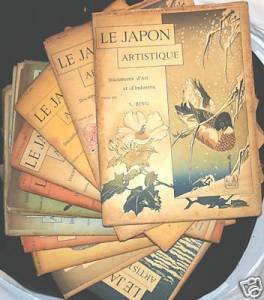
Bing's activities were of import, perhaps crucial, to the Japanese influence on Art Nouveau. He published a monthly journal, Le Japon Artistique, which began in 1888 and was nerveless in 36 volumes in 1891. The periodical is known to accept had a bully influence on artists similar Gustav Klimt and George Hendrik Breitner. And here I come up full circumvolve once more every bit this painting by Breitner was one of my favourite paintings when I was a little daughter! I bought a postcard of the painting which hang above my bed for many years.

Thanks to industrialisation (and the opportunity to mass-produce) tiles experienced a major revival. They were waterproof, fireproof and pollutionproof, and relatively cheap (compared to plastering, they accept a longer lasting clothing and lower installation cost. They also cost far less than rock). And because they were easy to make clean, they also became very pop with the rise of the bath and the greater appreciation of the benefit of hygene in the kitchen. In the late 19th century, epidemics were nonetheless very lethal! As yous can meet below, Art Nouveau artists adapted to this new building material quickly past designing the well-nigh beautiful handmade patterned tiles!



As well new building materials such as glass, reinforced concrete, cast iron & steel became available to Art Nouveau artists thanks to the industrial revolution. One of the principal 'new' building materials was bandage iron which had actually been invented in 6th century China. It was only after the industrial revolution that new production methods first allowed cast iron to exist produced cheaply plenty and in large enough quantities to regularly exist used in big building projects. Bandage fe was usually made from pig iron which had to be heated until it liquefied, and was and so poured into a mould to solidify. Information technology was more often than not used for columns every bit cast fe is insufficiently breakable but very strong under compression. (Non under tension!) Cast iron columns enabled architects to build alpine buildings without the enormously thick walls required to construct masonry buildings of whatever summit. Such flexibility immune tall buildings to have large windows and let daylight enter. Slender cast fe columns could besides support the weight that would otherwise require thick masonry columns or piers, opening upward floor spaces in factories, and enabling architects of theaters, churches and synagogues to improve sight lines when supporting balconies.

The utilize of large drinking glass surfaces in buildings grew during the second office of the 19th century with the growing popularity of cast iron. Glass was used for functional reasons (large windows creating luminous living spaces) as well as decorative reasons (stained glass). And while stained and leaded glass permit in the wanted low-cal, it still provided privacy for the home possessor. Skylights in individual houses became a new phenomenon.

Reinforced Concrete by François Hennebique
And last but non least, reinforced concrete was added to the list of new building materials. Though a concrete house was built every bit early on as 1837 past J.B. White of England, cement did not become widely adopted until the 1850s and 60s when it was used for sewer systems. It nevertheless remained as well expensive for large-scale use until the 1900s.
In 1879 the Belgian François Hennebique enclosed wrought fe beams in cement, initially, to protect them from fire and corrosion, besides as from the chemic fumes found in factories; From 1892, later on several new discoveries had been done, Hennebique replaced the atomic number 26 with steel and started to use his Béton Armé (reinforced concrete) in all supports (walls, columns, beams and ceilings). As of import, he and then started to realise that he needed to combine those supports into a monolithic chemical element using hooked connections. This and so called Hennebique system was one of the first appearances of the modern reinforced physical method of structure. The first building erected using this system was the 1897 Weaver Building in what was then the Docks area of Swansea.
The final footstep was taken in the early on 1900s past Eugène Freyssinet, who recalculated all the formulas for reinforced cencrete and in the process re-developed pre-stressed concrete, which enabled curved supports to carry much greater loads and counteracted deterioration of the concrete itself under pressure. From hither on, buildings could become much larger and could be congenital faster than ever before.
Recognition of Art Nouveau architecture by UNESCO
Although Art Nouveau was replaced past 20th-century modernist styles fairly quickly, information technology is considered today as an important transition between the historicism of Neoclassicism and modernism. Furthermore, Art Nouveau monuments are now recognised by UNESCO on their Earth Heritage Listing equally significant contributions to cultural heritage. The historic eye of Riga, Latvia (nevertheless on my bucket listing!), with "the finest drove of Fine art Nouveau buildings in Europe", was added to the list during 1997 in part because of the "quality and the quantity of its Art Nouveau/Jugendstil architecture". And in the yr 2000, four Brussels town houses by Victor Horta were added as "works of man artistic genius" that are "outstanding examples of Art Nouveau architecture brilliantly illustrating the transition from the 19th to the 20th century in fine art, thought, and lodge".
ane Quoted "Villa Majorelle: inside an Art Nouveau restoration" in Fiscal Times
Read more than:
Art Nouveau (Flemmish Paper OKV1977)
Le Béton Armé (1898-1939)
Fine art Nouveau – History and Legacy
What is Art Nouveau?
Nieuwe Kunst (in Dutch)
Source: https://aboutartnouveau.wordpress.com/2012/09/05/art-nouveau-in-history/
0 Response to "Picture of a Art Nouveau Mirror Picture of Some One Falling of the Effle Tower"
Post a Comment