Vincent Van Gogh the Starry Night Vincent Van Gogh the Starry Night Spogebob Art
| The Starry Dark | |
|---|---|
 | |
| Artist | Vincent van Gogh |
| Year | 1889 |
| Catalogue |
|
| Medium | Oil on canvas |
| Dimensions | 73.seven cm × 92.one cm (29.01 in × 36.26 in) |
| Location | Museum of Modern Art, New York City |
The Starry Dark is an oil-on-sheet painting by the Dutch Post-Impressionist painter Vincent van Gogh. Painted in June 1889, it depicts the view from the east-facing window of his asylum room at Saint-Rémy-de-Provence, just before sunrise, with the addition of an imaginary village.[1] [2] [3] Information technology has been in the permanent collection of the Museum of Modern Art in New York City since 1941, caused through the Lillie P. Elation Bequest. Widely regarded as Van Gogh's magnum opus,[4] [5] The Starry Night is one of the about recognized paintings in Western art.[6] [7]
The asylum [edit]

The Monastery of Saint-Paul de Mausole
In the aftermath of the 23 Dec 1888 breakdown that resulted in the cocky-mutilation of his left ear,[viii] [9] Van Gogh voluntarily admitted himself to the Saint-Paul-de-Mausole lunatic aviary on 8 May 1889.[10] [xi] Housed in a former monastery, Saint-Paul-de-Mausole catered to the wealthy and was less than half full when Van Gogh arrived,[12] allowing him to occupy not only a second-story sleeping room but also a ground-flooring room for use equally a painting studio.[13]
During the yr Van Gogh stayed at the asylum in Saint-Rémy-de-Provence, the prolific output of paintings he had begun in Arles continued.[xiv] During this period, he produced some of the all-time-known works of his career, including the Irises from May 1889, now in the J. Paul Getty Museum, and the blue self-portrait from September, 1889, in the Musée d'Orsay. The Starry Night was painted mid-June past around eighteen June, the date he wrote to his blood brother Theo to say he had a new study of a starry sky.[1] [fifteen] [xvi] [L 1]
The painting [edit]

Van Gogh'due south sleeping room in the asylum
Although The Starry Night was painted during the day in Van Gogh's ground-flooring studio, it would be inaccurate to state that the picture was painted from memory. The view has been identified equally the one from his sleeping room window, facing east,[1] [2] [17] [eighteen] a view which Van Gogh painted variations of no fewer than twenty-one times,[ commendation needed ] including The Starry Night. "Through the iron-barred window," he wrote to his blood brother, Theo, around 23 May 1889, "I tin see an enclosed foursquare of wheat ... above which, in the morning time, I scout the sun rise in all its glory."[two] [L ii]
Van Gogh depicted the view at different times of the twenty-four hours and under various conditions conditions, such as the sunrise, moonrise, sunshine-filled days, overcast days, windy days, and 1 day with pelting. While the hospital staff did not permit Van Gogh to pigment in his bedroom, he was able in that location to make sketches in ink or charcoal on paper; eventually, he would base newer variations on previous versions. The pictorial chemical element uniting all of these paintings is the diagonal line coming in from the right depicting the low rolling hills of the Alpilles mountains. In fifteen of the twenty-one versions, cypress copse are visible across the far wall enclosing the wheat field. Van Gogh telescoped the view in 6 of these[ vague ] paintings, most notably in F717 Wheat Field with Cypresses and The Starry Dark, bringing the trees closer to the picture aeroplane.[ citation needed ]
I of the beginning paintings of the view was F611 Mountainous Landscape Backside Saint-Rémy, now in Copenhagen. Van Gogh made a number of sketches for the painting, of which F1547 The Enclosed Wheatfield After a Storm is typical. It is unclear whether the painting was made in his studio or exterior. In his 9 June letter describing it, he mentions he had been working outside for a few days.[19] [xx] [L 3] [15] Van Gogh described the second of the two landscapes he mentions he was working on, in a letter to his sis Wil on 16 June 1889.[19] [L four] This is F719 Green Wheat Field with Cypress, now in Prague, and the outset painting at the asylum he definitely painted en plein air.[19] F1548 Wheatfield, Saint-Rémy de Provence, now in New York, is a study for it. Ii days later, Vincent wrote to Theo stating that he had painted "a starry sky".[21] [L 1]
The Starry Dark is the just nocturne in the serial of views from his chamber window. In early June, Vincent wrote to Theo, "This morning I saw the countryside from my window a long time before sunrise with zippo but the morn star, which looked very big".[L 5] Researchers have determined that Venus (sometimes referred to as the "morning star") was indeed visible at dawn in Provence in the spring of 1889, and was at that fourth dimension almost equally bright as possible. So the brightest "star" in the painting, but to the viewer's right of the cypress tree, is really Venus.[xv] [17]
The Moon is stylized, every bit astronomical records indicate that it actually was waning gibbous at the time Van Gogh painted the picture show,[15] and fifty-fifty if the phase of the Moon had been its waning crescent at the time, Van Gogh's Moon would not take been astronomically correct. (For other interpretations of the Moon, run across below.) The 1 pictorial element that was definitely non visible from Van Gogh's cell is the village,[22] which is based on a sketch F1541v fabricated from a hillside in a higher place the hamlet of Saint-Rémy.[3] Pickvance thought F1541v was done later, and the steeple more Dutch than Provençal, a conflation of several Van Gogh had painted and drawn in his Nuenen menstruation, and thus the first of his "reminisces of the Due north" he was to pigment and draw early the following year.[one] Hulsker thought a landscape on the reverse F1541r was also a report for the painting.[23]

Interpretations [edit]
Despite the large number of letters Van Gogh wrote, he said very lilliputian about The Starry Night.[1] After reporting that he had painted a starry heaven in June, Van Gogh next mentioned the painting in a letter to Theo on or about twenty September 1889, when he included it in a list of paintings he was sending to his brother in Paris, referring to it as a "night study."[24] Of this list of paintings, he wrote, "All in all the only things I consider a niggling expert in information technology are the Wheatfield, the Mountain, the Orchard, the Olive trees with the bluish hills and the Portrait and the Entrance to the quarry, and the rest says nothing to me"; "the residual" would include The Starry Night. When he decided to hold back 3 paintings from this batch in order to relieve money on postage, The Starry Night was ane of the paintings he did not send.[25] Finally, in a letter to painter Émile Bernard from tardily November 1889, Van Gogh referred to the painting as a "failure."[26]
Van Gogh argued with Bernard and peculiarly Paul Gauguin as to whether one should paint from nature, as Van Gogh preferred,[27] or paint what Gauguin called "abstractions":[28] paintings conceived in the imagination, or de tête.[29] In the alphabetic character to Bernard, Van Gogh recounted his experiences when Gauguin lived with him for 9 weeks in the autumn and winter[ clarification needed ] of 1888: "When Gauguin was in Arles, I once or twice immune myself to be led astray into abstraction, equally you know. . . . But that was delusion, dear friend, and 1 soon comes up against a brick wall. . . And yet, once once again I immune myself to be led astray into reaching for stars that are likewise big—another failure—and I take had my fill of that."[thirty] Van Gogh hither is referring to the expressionistic swirls which boss the upper center portion of The Starry Dark.[31]
Theo referred to these pictorial elements in a letter to Vincent dated 22 October 1889: "I clearly sense what preoccupies yous in the new canvases like the village in the moonlight [The Starry Night] or the mountains, merely I feel that the search for fashion takes abroad the real sentiment of things."[26] Vincent responded in early Nov, "Despite what you say in your previous alphabetic character, that the search for style ofttimes harms other qualities, the fact is that I feel myself greatly driven to seek manner, if yous like, merely I hateful by that a more than manly and more deliberate drawing. If that volition brand me more like Bernard or Gauguin, I tin can't do annihilation about it. Simply am inclined to believe that in the long run you'd get used to it." And later in the same letter, he wrote, "I know very well that the studies fatigued with long, sinuous lines from the last consignment weren't what they ought to become, all the same I dare urge y'all to believe that in landscapes one volition continue to mass things by means of a cartoon style that seeks to express the entanglement of the masses."[32]
But although Van Gogh periodically defended the practices of Gauguin and Bernard, each fourth dimension he inevitably repudiated them[33] and connected with his preferred method of painting from nature.[34] Like the impressionists he had met in Paris, specially Claude Monet, Van Gogh besides favored working in series. He had painted his series of sunflowers in Arles, and he painted the serial of cypresses and wheat fields at Saint-Rémy. The Starry Nighttime belongs to this latter series,[35] every bit well equally to a pocket-size series of nocturnes he initiated in Arles.

The nocturne serial was limited by the difficulties posed by painting such scenes from nature, i.e., at night.[36] The first painting in the series was Café Terrace at Night, painted in Arles in early September 1888, followed by Starry Night (Over the Rhône) afterward that same month. Van Gogh's written statements concerning these paintings provide further insight into his intentions for painting night studies in full general and The Starry Night in detail.
Soon after his inflow in Arles in February 1888, Van Gogh wrote to Theo, "I need a starry night with cypresses or—perhaps above a field of ripe wheat; at that place are some really cute nights here." That same week, he wrote to Bernard, "A starry sky is something I should like to try to do, just as in the daytime I am going to endeavor to pigment a green meadow spangled with dandelions."[37] He compared the stars to dots on a map and mused that, every bit one takes a train to travel on Globe, "we accept death to reach a star."[38] Although at this point in his life Van Gogh was disillusioned by religion,[39] [40] he appears not to have lost his belief in an afterlife. He voiced this ambivalence in a letter to Theo afterwards having painted Starry Nighttime Over the Rhône, confessing to a "tremendous need for, shall I say the give-and-take—for religion—so I go exterior at night to paint the stars."[41]
He wrote nigh existing in some other dimension afterward death and associated this dimension with the night sky. "It would be so simple and would business relationship so much for the terrible things in life, which at present amaze and wound us so, if life had yet another hemisphere, invisible information technology is truthful, but where one lands when one dies."[42] "Hope is in the stars," he wrote, only he was quick to point out that "world is a planet too, and consequently a star, or celestial orb."[37] And he stated flatly that The Starry Nighttime was "non a return to the romantic or to religious ideas."[43]
Noted art historian Meyer Schapiro highlights the expressionistic aspects of The Starry Night, proverb information technology was created nether the "pressure level of feeling" and that information technology is a "visionary [painting] inspired by a religious mood."[44] Schapiro theorizes that the "hidden content"[44] of the work makes reference to the New Testament book of Revelation, revealing an "apocalyptic theme of the woman in hurting of birth, girded with the dominicus and moon and crowned with stars, whose newborn kid is threatened by the dragon."[45] (Schapiro, in the same volume, likewise professes to encounter an epitome of a mother and kid in the clouds in Mural with Olive Trees,[46] painted at the same time and oftentimes regarded every bit a pendant to The Starry Night.)[47]
Fine art historian Sven Loevgren expands on Schapiro'south approach, once more calling The Starry Night a "visionary painting" which "was conceived in a state of great agitation."[48] He writes of the "hallucinatory character of the painting and its violently expressive form," although he takes pains to notation that the painting was not executed during one of Van Gogh'southward incapacitating breakdowns.[49] Loevgren compares Van Gogh's "religiously inclined longing for the beyond" to the poetry of Walt Whitman.[fifty] He calls The Starry Night "an infinitely expressive picture which symbolizes the terminal absorption of the artist by the cosmos" and which "gives a never-to-be-forgotten sensation of standing on the threshold of eternity."[51] Loevgren praises Schapiro's "eloquent interpretation" of the painting as an apocalyptic vision[52] and advances his ain symbolist theory with reference to the 11 stars in one of Joseph'southward dreams in the Sometime Testament book of Genesis.[53] Loevgren asserts that the pictorial elements of The Starry Night "are visualized in purely symbolic terms" and notes that "the cypress is the tree of death in the Mediterranean countries."[54]

Fine art historian Lauren Soth likewise finds a symbolist subtext in The Starry Night, proverb that the painting is a "traditional religious subject in disguise"[57] and a "sublimated image of [Van Gogh's] deepest religious feelings."[58] Citing Van Gogh's avowed admiration for the paintings of Eugène Delacroix, and peculiarly the earlier painter's use of Prussian blue and citron yellow in paintings of Christ, Soth theorizes that Van Gogh used these colors to represent Christ in The Starry Night.[59] He criticizes Schapiro'south and Loevgren'south biblical interpretations, dependent as they are on a reading of the crescent moon as incorporating elements of the Sunday. He says it is just a crescent moon, which, he writes, also had symbolic meaning for Van Gogh, representing "consolation."[60]
Information technology is in lite of such symbolist interpretations of The Starry Night that art historian Albert Boime presents his study of the painting. As noted above, Boime has proven that the painting depicts not only the topographical elements of Van Gogh's view from his asylum window but too the celestial elements, identifying not but Venus but also the constellation Aries.[17] He suggests that Van Gogh originally intended to paint a gibbous Moon but "reverted to a more traditional prototype" of the crescent moon, and theorizes that the brilliant aureole around the resulting crescent is a remnant of the original gibbous version.[22] He recounts Van Gogh'south interest in the writings of Victor Hugo and Jules Verne as possible inspiration for his belief in an afterlife on stars or planets.[61] And he provides a detailed word of the well-publicized advances in astronomy that took place during Van Gogh'south lifetime.
Boime asserts that while Van Gogh never mentioned astronomer Camille Flammarion in his letters,[62] he believes that Van Gogh must accept been aware of Flammarion's popular illustrated publications, which included drawings of spiral nebulae (equally galaxies were then called) as seen and photographed through telescopes. Boime interprets the swirling effigy in the central portion of the sky in The Starry Dark to stand for either a spiral galaxy or a comet, photographs of which had also been published in pop media.[22] He asserts that the only non-realistic elements of the painting are the village and the swirls in the sky. These swirls represent Van Gogh'southward understanding of the cosmos equally a living, dynamic place.[63]
Harvard astronomer Charles A. Whitney conducted his ain astronomical study of The Starry Night contemporaneously with only independent of Boime (who spent almost his entire career at U.C.L.A.).[64] While Whitney does not share Boime'southward certainty with regard to the constellation Aries,[65] he concurs with Boime on the visibility of Venus in Provence at the time the painting was executed.[15] He also sees the delineation of a screw galaxy in the sky, although he gives credit for the original to Anglo-Irish astronomer William Parsons, Lord Rosse, whose work Flammarion reproduced.[66]

Whitney likewise theorizes that the swirls in the heaven could represent wind, evoking the mistral that had such a profound effect on Van Gogh during the xx-seven months he spent in Provence.[18] (It was the mistral which triggered his commencement breakdown after entering the aviary, in July 1889, less than a calendar month after painting The Starry Night.)[67] Boime theorizes that the lighter shades of blue just in a higher place the horizon bear witness the starting time lite of morning.[22]
The hamlet has been variously identified as either a recollection of Van Gogh's Dutch homeland,[1] [68] or based on a sketch he fabricated of the town of Saint-Rémy.[3] [22] In either instance, information technology is an imaginary component of the picture, non visible from the window of the asylum chamber.
Cypress trees take long been associated with death in European culture, though the question of whether Van Gogh intended for them to accept such a symbolic meaning in The Starry Night is the subject of an open debate. In an April 1888 letter to Bernard, Van Gogh referred to "funereal cypresses,"[69] though this is possibly similar to saying "stately oaks" or "weeping willows." One week subsequently painting The Starry Dark, he wrote to his brother Theo, "The cypresses are always occupying my thoughts. I should like to make something of them similar the canvases of the sunflowers, because it astonishes me that they have non yet been done equally I see them."[70] In the same letter he mentioned "two studies of cypresses of that hard shade of bottle light-green."[71] These statements advise that Van Gogh was interested in the trees more for their formal qualities than for their symbolic connotation.
Schapiro refers to the cypress in the painting every bit a "vague symbol of a man striving."[44] Boime calls it the "symbolic analogue of Van Gogh's own striving for the Space through non-orthodox channels."[62] Art historian Vojtech Jirat-Wasiutynski says that for Van Gogh the cypresses "function as rustic and natural obelisks" providing a "link betwixt the heavens and the earth."[72] (Some commentators see one tree, others see two or more.) Loevgren reminds the reader that "the cypress is the tree of death in the Mediterranean countries."[54]
Fine art historian Ronald Pickvance says that with "its arbitrary collage of divide motifs," The Starry Night "is overtly stamped as an 'brainchild'."[73] Pickvance claims that cypress trees were non visible facing east from Van Gogh's room, and he includes them with the hamlet and the swirls in the sky as products of Van Gogh's imagination.[1] Boime asserts that the cypresses were visible in the e,[17] as does Jirat-Wasiutyński.[74] Van Gogh biographers Steven Naifeh and Gregory White Smith agree, maxim that Van Gogh "telescoped" the view in certain of the pictures of the view from his window,[21] and it stands to reason that Van Gogh would do this in a painting featuring the Morning time Star. Such a pinch of depth serves to enhance the effulgence of the planet.
Soth uses Van Gogh's argument to his blood brother, that The Starry Dark is "an exaggeration from the point of view of arrangement" to further his statement that the painting is "an amalgam of images."[75] However, it is by no ways sure that Van Gogh was using "arrangement" every bit a synonym for "composition." Van Gogh was, in fact, speaking of three paintings, one of which was The Starry Night, when he made this annotate: "The olive trees with white cloud and background of mountains, as well as the Moonrise and the Night event," every bit he called information technology, "these are exaggerations from the betoken of view of the system, their lines are contorted like those of the ancient woodcuts." The showtime 2 pictures are universally acknowledged to be realistic, not-composite views of their subjects. What the three pictures do accept in common is exaggerated color and brushwork of the type that Theo referred to when he criticized Van Gogh for his "search for style [that] takes away the existent sentiment of things" in The Starry Night.
On two other occasions around this fourth dimension, Van Gogh used the word "organization" to refer to color, similar to the manner James Abbott McNeill Whistler used the term. In a letter to Gauguin in January 1889, he wrote, "As an arrangement of colours: the reds moving through to pure oranges, intensifying even more than in the flesh tones up to the chromes, passing into the pinks and marrying with the olive and Veronese greens. As an impressionist organization of colours, I've never devised anything better."[76] (The painting he is referring to is La Berceuse, which is a realistic portrait of Augustine Roulin with an imaginative floral background.) And to Bernard in belatedly November 1889: "But this is enough for you to empathize that I would long to see things of yours again, similar the painting of yours that Gauguin has, those Breton women walking in a meadow, the arrangement of which is so beautiful, the colour and then naively distinguished. Ah, you're exchanging that for something—must one say the word—something artificial—something affected."[77] [78]
While stopping brusque of calling the painting a hallucinatory vision, Naifeh and Smith discuss The Starry Dark in the context of Van Gogh's mental illness, which they identify as temporal lobe epilepsy, or latent epilepsy.[79] "Non the kind," they write, "known since artifact, that caused the limbs to wiggle and the body to plummet ('the falling sickness', as it was sometimes chosen), but a mental epilepsy—a seizing up of the mind: a collapse of thought, perception, reason, and emotion that manifested itself entirely in the brain and often prompted bizarre, dramatic behavior."[80] Symptoms of the seizures "resembled fireworks of electrical impulses in the brain."[31]
Van Gogh experienced his 2nd breakup in 7 months in July 1889.[67] Naifeh and Smith theorize that the seeds of this breakdown were nowadays when Van Gogh painted The Starry Night, that in giving himself over to his imagination "his defenses had been breached."[81] On that day in mid-June, in a "state of heightened reality," with all the other elements of the painting in identify,[82] Van Gogh threw himself into the painting of the stars, producing, they write, "a dark sky unlike any other the world had ever seen with ordinary eyes."[31]
Provenance [edit]
After having initially held information technology back, Van Gogh sent The Starry Night to Theo in Paris on 28 September 1889, along with nine or ten other paintings.[25] [73] Theo died less than six months after Vincent, in Jan 1891. Theo's widow Jo became the caretaker of Van Gogh'south legacy. In Paris in 1900 she sold the painting to poet Julien Leclercq. In 1901 Leclercq sold it to Gauguin's old friend Émile Schuffenecker. Jo bought the painting back from Schuffenecker and in 1906 sold information technology to the Oldenzeel Gallery in Rotterdam. From 1906 to 1938 it was owned by Georgette P. van Stolk, of Rotterdam, who sold it to Paul Rosenberg, of Paris and New York. Information technology was through Rosenberg that the Museum of Modernistic Art acquired the painting in 1941.[83]
Painting materials [edit]
The painting was investigated by the scientists at the Rochester Constitute of Engineering science and the Museum of Modern Art in New York.[84] The pigment analysis has shown that the sky was painted with ultramarine and cobalt blueish, and for the stars and the moon, Van Gogh employed the rare pigment indian yellow together with zinc yellowish.[85]
- Details of Van Gogh's The Starry Dark exhibited at the Museum of Modern Art of New York.
-
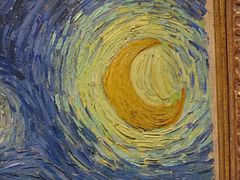
Moon
-

Venus
-

Hills and heaven
-

Left function of the canvas and frame
-

Stars in the sky
Encounter also [edit]
- Baldin Collection
- "Vincent", 1971 song by Don McLean written every bit a tribute to Vincent van Gogh
- Timbres, espace, mouvement: an orchestral work (1978) by Henri Dutilleux inspired by the painting
References [edit]
- Citations
- ^ a b c d e f g Pickvance 1986, p. 103
- ^ a b c Naifeh & Smith 2011, p. 747
- ^ a b c Naifeh & Smith 2011, p. 760
- ^ "Vincent van Gogh Biography, Art, and Analysis of Works". The Art Story . Retrieved 12 June 2015.
Starry Night is often considered to exist Van Gogh's tiptop achievement.
- ^ "Vincent van Gogh Paintings, 50 of his best works of art". Growth Skills. 8 March 2013. Retrieved 18 Baronial 2020. [ permanent dead link ]
- ^ Moyer, Edward (14 February 2012). "Interactive canvas lets viewers stir Van Gogh'south 'Starry Night'". CNET News . Retrieved 12 June 2015.
...1 of the West's almost iconic paintings: Vincent van Gogh's 'The Starry Nighttime.'
- ^ Kim, Hannah (27 May 2010). "Vincent van Gogh's The Starry Night, at present small!". MoMA . Retrieved 12 June 2015.
Instantly recognizable and an iconic prototype in our culture, Vincent van Gogh'due south The Starry Night is a touchstone of modern art and ane of the most beloved works...
- ^ Naifeh & Smith 2011, pp. 701–7
- ^ Pickvance 1984, p. 159
- ^ Naifeh & Smith 2011, pp. 741–3
- ^ Pickvance 1986, pp. 25–vi
- ^ Naifeh & Smith 2011, p. 746
- ^ Naifeh & Smith 2011, p. 754
- ^ Naifeh & Smith 2011, pp. 592, 778
- ^ a b c d e Whitney 1986, p. 356
- ^ Naifeh & Smith 2011, pp. 759–61
- ^ a b c d Boime 1984, p. 88
- ^ a b Whitney 1986, p. 358
- ^ a b c Hulsker 1986, p. 394
- ^ Pickvance 1986, p. 93
- ^ a b Naifeh & Smith 2011, p. 759
- ^ a b c d east Boime 1984, p. 89
- ^ Hulsker 1986, p. 396
- ^ Van Gogh Letters Projection, no. 805
- ^ a b Van Gogh Letters Projection, no. 806
- ^ a b Naifeh & Smith 2011, p. 784
- ^ Naifeh & Smith 2011, p. 755
- ^ Naifeh & Smith 2011, p. 625n
- ^ Naifeh & Smith 2011, p. 674
- ^ de Leeuw, Ronald (ed.) (1996). The Letters of Vincent van Gogh. London: Penguin Books. p. 469. ISBN978-0-140-44674-half-dozen.
- ^ a b c Naifeh & Smith 2011, p. 762
- ^ Van Gogh Letters Projection, no. 816
- ^ Naifeh & Smith 2011, pp. 626, 680
- ^ Naifeh & Smith 2011, p. 778
- ^ Schapiro, Meyer (1950). Vincent van Gogh. New York: H. Due north. Abrams. p. 110.
- ^ Naifeh & Smith 2011, p. 650
- ^ a b Naifeh & Smith 2011, p. 649
- ^ Naifeh & Smith 2011, p. 611
- ^ Soth 1986, p. 301
- ^ Naifeh & Smith 2011, p. 766
- ^ Naifeh & Smith 2011, p. 651
- ^ Naifeh & Smith 2011, p. 858n
- ^ Naifeh & Smith 2011, p. 767
- ^ a b c Schapiro, p. 100
- ^ Schapiro, p. 33
- ^ Schapiro, p. 108
- ^ Pickvance 1986, p. 101
- ^ Loevgren 1971, p. 172
- ^ Loevgren 1971, pp. 172–73
- ^ Loevgren 1971, p. 181
- ^ Loevgren 1971, p. 182
- ^ Loevgren 1971, p. 183
- ^ Loevgren 1971, p. 186
- ^ a b Loevgren 1971, p. 184
- ^ The Sterling and Francine Clark Art Institute: Cypresses in Starry Night Archived 10 January 2013 at archive.today in the Lost Art digital collection. Retrieved 3 June 2012.
- ^ Richard Boudreaux: "Ex-Soviet Officeholder Tried to Render Art Found in Cellar", Los Angeles Times twenty March 1995, retrieved 3 June 2012.
- ^ Soth 1986, p. 308
- ^ Soth 1986, p. 312
- ^ Soth 1986, p. 307
- ^ Soth 1986, p. 309
- ^ Boime 1984, p. 95
- ^ a b Boime 1984, p. 96
- ^ Boime 1984, p. 92
- ^ Rourke, Mary. "Fine art historian viewed works from social, political standpoints". Los Angeles Times . Retrieved 16 August 2014.
- ^ Whitney 1986, p. 352
- ^ Whitney 1986, p. 351
- ^ a b Naifeh & Smith 2011, p. 771
- ^ Schapiro, p. 34
- ^ Pickvance 1984, p. 181
- ^ Naifeh & Smith 2011, p. 758
- ^ Van Gogh Messages Project, no. 783
- ^ Jirat-Wasiutynski, p. 657
- ^ a b Pickvance 1986, p. 106
- ^ Jirat-Wasiutynski, p. 667
- ^ Soth 1986, p. 305
- ^ Van Gogh Letters Project, no. 739
- ^ Van Gogh Letters Project, no. 822
- ^ Naifeh & Smith 2011, p. 675
- ^ Naifeh & Smith 2011, pp. 762–763
- ^ Naifeh & Smith 2011, p. 749; accent in the original
- ^ Naifeh & Smith 2011, p. 763
- ^ Naifeh & Smith 2011, p. 761
- ^ "The Provenance Research Project". Museum of Modern Fine art . Retrieved 16 August 2014.
- ^ Yonghui Zhao, Roy S. Berns, Lawrence A. Taplin, James Coddington, An Investigation of Multispectral Imaging for the Mapping of Pigments in Paintings, in Proc. SPIE 6810, Figurer Paradigm Assay in the Report of Fine art, 681007 (29 February 2008)
- ^ Van Gogh, The Starry Night, illustrated pigment analysis, ColourLex
- Letters
- ^ a b "Alphabetic character 782:To Theo van Gogh. Saint-Rémy-de-Provence, on or nigh Tuesday, 18 June 1889". Vincent van Gogh: The Letters. Van Gogh Museum. 1v:2.
At last I accept a mural with olive trees, and likewise a new report of a starry sky.
- ^ "Letter 776: To Theo van Gogh. Saint-Rémy-de-Provence, on or about Th, 23 May 1889". Vincent van Gogh: The Messages. Van Gogh Museum. 1v:2.
Through the iron-barred window I tin make out a square of wheat in an enclosure, a perspective in the style of Van Goyen, above which in the morning I see the sunday rise in its glory.
- ^ "Alphabetic character 779: To Theo van Gogh. Saint-Rémy-de-Provence, Lord's day, 9 June 1889". Vincent van Gogh: The Letters. Van Gogh Museum. 1v:ii.
... for a few days now I've been going outside to work in the neighbourhood... I is the countryside that I glimpse from the window of my sleeping room. In the foreground, a field of wheat, ravaged and knocked to the ground subsequently a storm. A boundary wall and across, grey leaf of a few olive trees, huts and hills. Finally, at the top of the painting, a large white and grey deject swamped by the azure. Information technology'south a landscape of extreme simplicity — in terms of colouration as well.
- ^ "Letter of the alphabet 780: To Willemien van Gogh. Saint-Rémy-de-Provence, Sunday, 16 June 1889". Vincent van Gogh: The Letters. Van Gogh Museum. 1r:1.
Then yet some other that depicts a field of yellowing wheat surrounded past brambles and green bushes. At the end of the field a little pink house with a tall and dark cypress tree that stands out against the afar purplish and bluish hills, and against a forget-me-not bluish sky streaked with pink whose pure tones contrast with the already heavy, scorched ears, whose tones are as warm as the crust of a loaf of staff of life.
- ^ "Letter 777: To Theo van Gogh. Saint-Rémy-de-Provence, between near Friday, 31 May and about Thursday, 6 June 1889". Vincent van Gogh: The Messages. Van Gogh Museum. 1v:2.
This morning I saw the countryside from my window a long time before sunrise with cipher but the morning star, which looked very big.
- Sources
- Boime, Albert (December 1984). "Van Gogh's Starry Night: A History of Matter and a Thing of History" (PDF). Arts Magazine. 59 (iv): 86–103.
- De La Faille, Jacob Baart (1970). The works of Vincent van Gogh (third ed.). Amsterdam: Meulenhoff. OCLC 300160639.
- Ives, Colta; Stein, Susan Alyson; van Heugten, Sjraar; Vellekoop, Marije (2005). Vincent Van Gogh: The Drawings. New York: Metropolitan Museum of Art. ISBN978-1588391650.
- Hulsker, Jan (1986). The Consummate Van Gogh: Paintings, Drawings, Sketches. New York, NY: Harrison House/Harry North. Abrams Distributed by Crown Publishers, Random Business firm. ISBN0-517-44867-X.
- Jirat-Wasiutynski, Vojtech (December 1993). "Vincent van Gogh's Paintings of Olive Trees and Cypresses from St.-Remy". Art Bulletin. 75 (4). JSTOR 3045988.
- Loevgren, Sven (1971). The Genesis of Modernism: Seurat, Gauguin, Van Gogh, and French Symbolism in the 1880s . Bloomington: Indiana University Press. ISBN978-0253325600.
- Naifeh, Steven and Gregory White Smith (2011). Van Gogh: The Life. New York: Random Firm. ISBN978-0-375-50748-9.
- Pickvance, Ronald (1984). Van Gogh in Arles. New York: Metropolitan Museum of Art. ISBN0-87099-376-3.
- Pickvance, Ronald (1986). Van Gogh In Saint-Rémy and Auvers (exhibition catalog, Metropolitan Museum of Art) . New York: Metropolitan Museum of Art, Abrams. ISBN0-87099-477-8.
- Soth, Lauren (June 1986). "Van Gogh's Desperation". Art Bulletin. 68 (two): 301. doi:x.1080/00043079.1986.10788341.
- Whitney, Charles A. (September 1986). "The Skies of Vincent van Gogh". Art History. 9 (3): 351–362. doi:10.1111/j.1467-8365.1986.tb00206.x.
External links [edit]
- The Starry Night at the Museum of Mod Art
- The Starry Night at Who is van Gogh
- Van Gogh, paintings and drawings: a special loan exhibition, a fully digitized exhibition catalog from The Metropolitan Museum of Fine art Libraries, which contains material on this painting (see alphabetize)
- Aerial photo of monastery marking Vincent's bedroom Archived 24 Apr 2017 at the Wayback Car
- Vincent van Gogh, The Starry Night, ColourLex
- "12 Most Famous Paintings in History", paintandpainting.com
Source: https://en.wikipedia.org/wiki/The_Starry_Night
0 Response to "Vincent Van Gogh the Starry Night Vincent Van Gogh the Starry Night Spogebob Art"
Post a Comment