Small and mid-sized districts rely on partners to provide summer programs
United Way
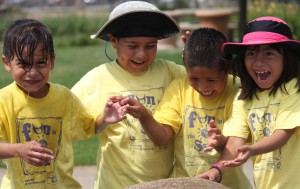
Summertime programs often focus on experiential learning. These students in Santa Barbara play at a water fountain during a field trip.
 United Way
Summer programs often focus on experiential learning. These students in Santa Barbara play at a h2o fountain during a field trip.
Despite well-established inquiry that shows the importance of keeping students active and learning during the summer, small and mid-sized districts oftentimes find information technology difficult to provide quality summertime programs because of the cost and logistical challenges they pose.
But some California districts accept met those challenges by partnering with canton offices of education, later on-school programs, local organizations and each other, according to a recent report from the Partnership for Children & Youth, an advancement group based in Oakland.
Successful summertime programs "look and feel similar summer camp merely incorporate intentional learning goals" and provide learning opportunities for low-income students that are often scarce during the summertime, co-ordinate to the report, "Investing in Summer Learning: Stories from the Field."
Without such opportunities, "students who continue pace and succeed during the schoolhouse yr ofttimes end up losing ground in the summer," according to the study.
The report highlights how 3 communities in 2022 pieced together summertime programs for low-income youth.
Fresno Canton
Kerman Unified and Fowler Unified, both mid-sized districts in Fresno Canton, wanted to concenter eye-school students to a summer program that provided bookish support, but with a more interactive, experiential approach to learning.
They looked to neighboring Primal Unified, which has worked with a local nonprofit, the California Education Fellows Foundation, to provide a summer program since 2009. Called Primal Enrichment Summertime Adventures, the plan is aligned with state English, math and science standards and actively engages students, who learn to program robots, problem shoot code and build circuits. Students likewise participate in projects connected to the dystopian novels that they are reading, such every bit building mazes when they read Maze Runner by James Dashner or designing the wearing apparel worn by tributes, who fight in the Hunger Games, the novel by Suzanne Collins. The students also practise community service projects such equally pulling weeds at Storyland Playland, Fresno's premier amusement park, said Rico Peralta, director of program evolution for the foundation.
In 2015, the foundation agreed to provide summer programs for the Kerman and Fowler districts at a cost of $17.50 per pupil per mean solar day for instructional materials and staffing. The Fresno County Office of Instruction provided staff evolution, preparation and some materials. The programs lasted six hours a twenty-four hour period for v weeks, and each district enrolled 100 students.
"I think traditional summertime school is non working, specially for heart school," said Robert Frausto, superintendent of Kerman Unified. "You get kids in a summer program if they want to be at that place. They're learning, but they're as well having fun."
Robert Frausto, superintendent of Kerman Unified, said in the past he had used summer for academic interventions for students who had fallen behind. At present, he said, the interventions happen during the school year when the help is more timely. That approach allows summer to be used to prevent learning loss.
"I think traditional summer school is not working, particularly for middle schoolhouse," Frausto said. "You become kids in a summer programme if they want to be in that location. They're learning, just they're also having fun."
Tehama and Glenn counties
In rural counties, students often are isolated during the summertime, many living far from towns and neighbors. In summertime 2015, the county offices of educational activity for Tehama and Glenn counties in north-central California provided summer programs for virtually fifteen,000 students from 23 school districts spread over about 4,000 foursquare miles.
The programs, which lasted for five weeks, were funded primarily by state Subsequently School Pedagogy & Safety Program grants and federal Migrant Education Program funds.
Districts provided facilities and some transportation. Outside organizations, including parks and recreation departments, other urban center agencies, community-based organizations and local businesses, besides contributed.
The emphasis was on hands-on learning. For example, students were able to accept advantage of the Tehama County Office of Pedagogy'southward "Makerspace" facility, where they could build circuits, wind tunnels and other structure projects.
"Customs organizations and businesses are all coming together and expecting more than for our kids," said Karla Stroman, the administrator in charge of the after-school and summertime programs for the county office. "A lot of that energy has been devoted to making summer programs available."
Mount View School Commune, urban center of El Monte, Los Angeles County
Relying on its after-schoolhouse partner, Think Together, the mid-sized Mountain View Schoolhouse District put together a camp-way summertime programme for 2,300 elementary and middle school students at 12 sites in 2015. The G-8 district also used the 5-calendar week program to railroad train its teachers, who practiced their new skills with the students in the program.
Mountain View, where almost all students are eligible for complimentary and reduced-toll meals, paid for the combination program by using $475,000 in supplemental and concentration grant funding it received for depression-income students and English learners through the state's Local Control Funding Formula. The cost was almost $220 per student.
The teachers attended an afternoon professional development session on teaching reading and how to utilize a figurer program chosen DORA to assess where students needed assist. The teachers then practiced those skills with the students the next morning. Assessments at the end of the program saw gains for the students, particularly in vocabulary, said Margarita Amador, director of curriculum and instruction.
"Professional development does non usually have a training format so you oft lose traction," said Raymond Andry, assistant superintendent of educational services. "Using summer equally a practicum experience – it's just smart."
Besides a focus on reading, the students participated in sports and trip the light fantastic and created their ain rap music. The programme likewise provided opportunities for the students who were in middle schoolhouse, generally an awkward menstruation in life, to build social skills, said teacher Chris Jimenez. They formed teams and created team chants. They put on a talent bear witness at the end.
The program "kept the kids interested," Jimenez said.
To go more reports like this 1, click here to sign up for EdSource's no-price daily email on latest developments in education.
Source: https://edsource.org/2016/small-and-mid-sized-districts-rely-on-partners-to-provide-summer-programs/95023
0 Response to "Small and mid-sized districts rely on partners to provide summer programs"
Post a Comment